

Research library
Browse the association's papers, technical reports and studies.
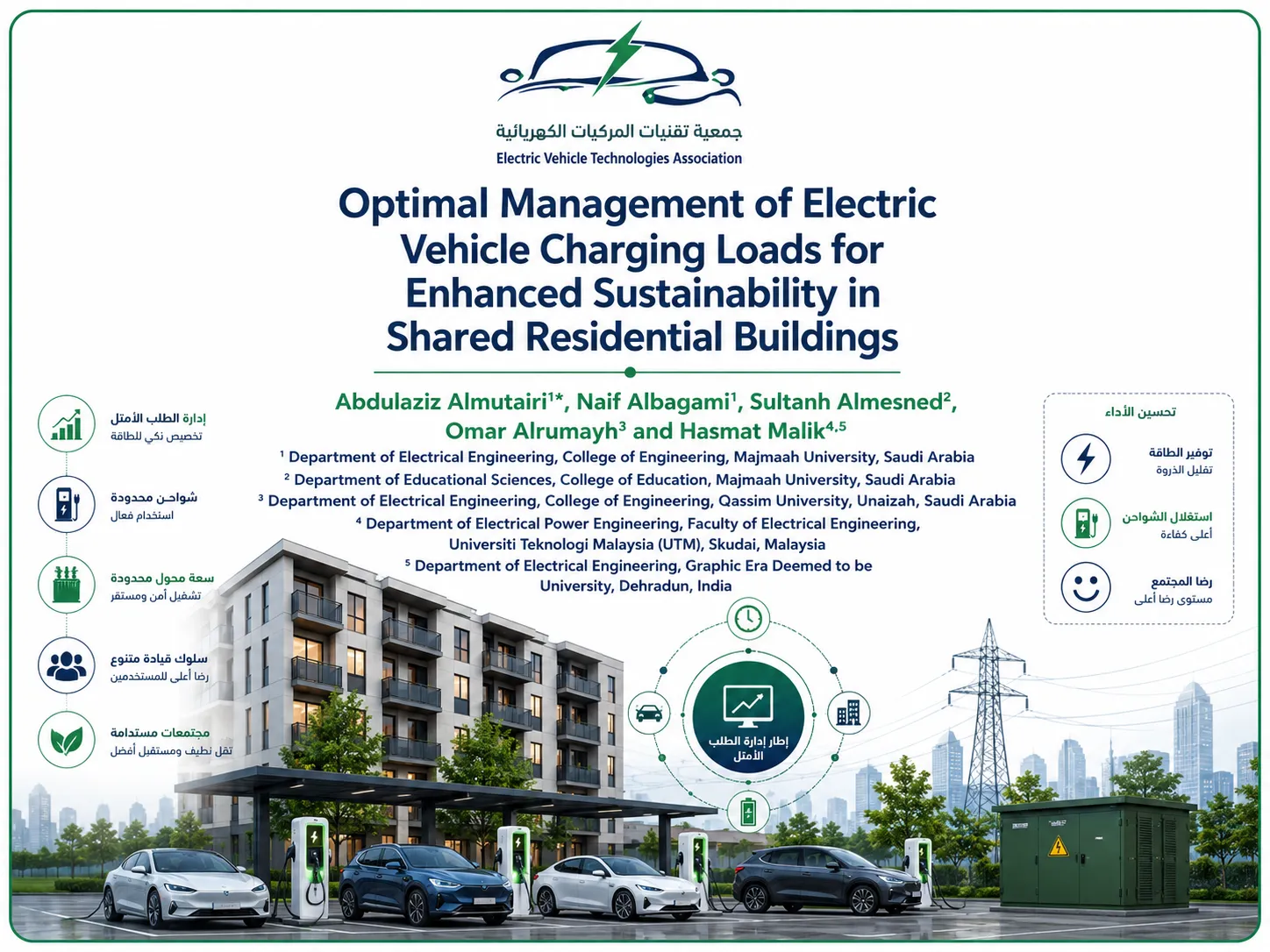
Optimal Management of Electric Vehicle Charging Loads for Enhanced Sustainability in Shared Residential Buildings
Abdulaziz Almutairi, Naif Albagami, Sultanh Almesned, Omar Alrumayh, Hasmat Malik
Majmaah University, Qassim University, Universiti Teknologi Malaysia (UTM), Graphic Era Deemed to be University
This study proposes an optimal demand management framework for EV charging in shared residential parking lots, considering limited charger availability, transformer capacity, and diverse driving behavior. Driver behavior and energy consumption are estimated, and a linear programming-based optimization model is used to efficiently allocate available power among EVs. A satisfaction index is introduced to assess EV community satisfaction, while performance is evaluated based on power usage, charger utilization, and user satisfaction. The framework supports efficient and sustainable EV integration in shared residential buildings.

Electric Vehicle Load Estimation at Home and Workplace in Saudi Arabia for Grid Planners and Policy Makers
Abdulaziz Almutairi, Naif Albagami, Sultanh Almesned, Omar Alrumayh, Hasmat Malik
Majmaah University, Qassim University, Universiti Teknologi Malaysia (UTM), Graphic Era Deemed to be University
This study proposes a tailored approach for estimating electric vehicle charging loads in Saudi Arabia using real survey data on driving and commuting behaviors. The methodology analyzes daily mileage, home and workplace arrival/departure times, and trip patterns to develop per-unit EV charging profiles. These profiles are then applied to different scenarios involving Level 1 and Level 2 chargers and residential, commercial, and mixed-use buildings. The results indicate that mixed-use buildings can reduce EV peak loads, with an approximately 50% commercial-to-residential ratio producing the lowest peak demand. The findings provide valuable information for grid planners and policymakers in planning EV charging infrastructure and managing future electricity demand.
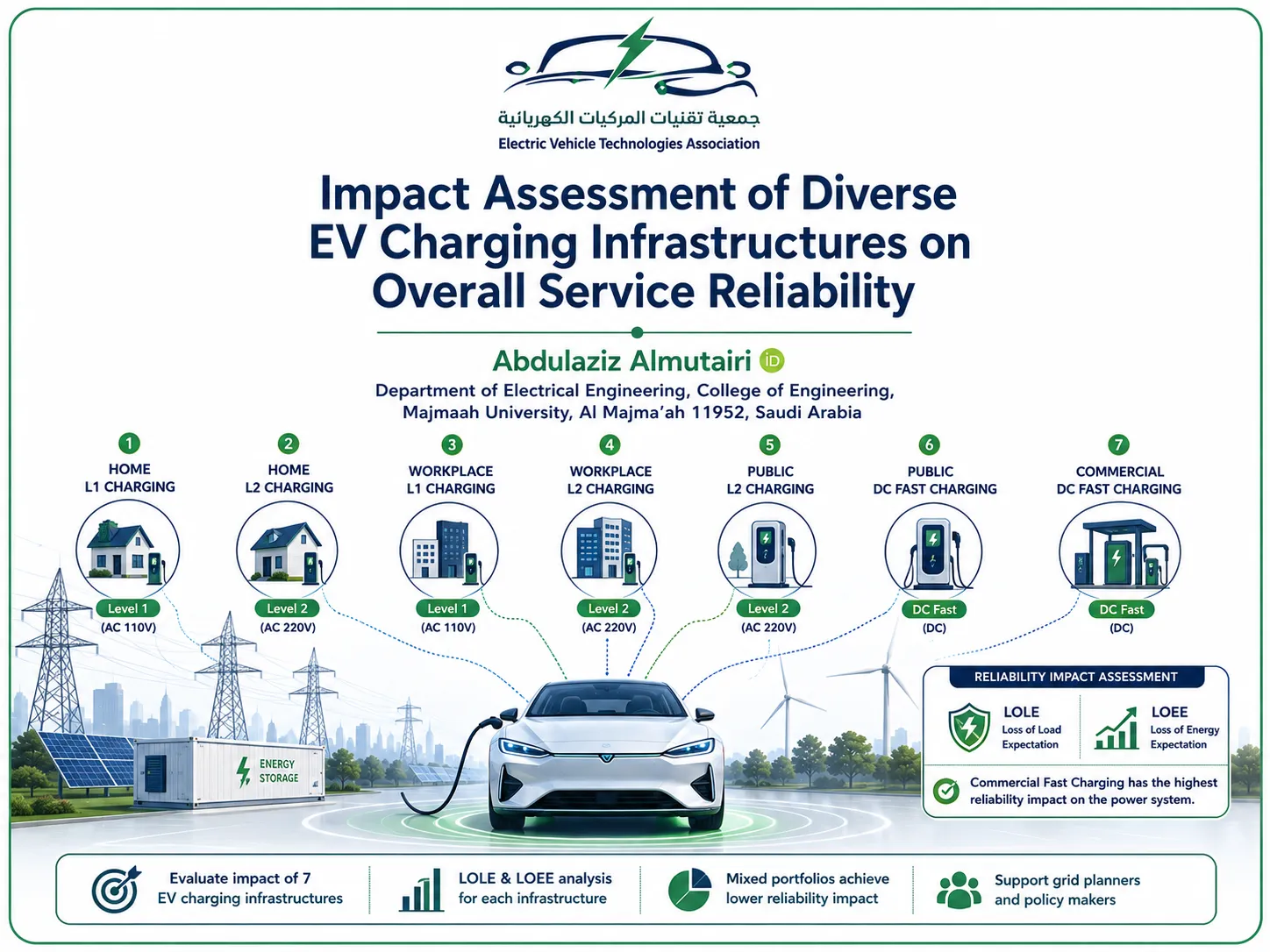
Impact Assessment of Diverse EV Charging Infrastructures on Overall Service Reliability
Abdulaziz Almutairi
Majmaah University
This study assesses the impact of diverse electric vehicle charging infrastructures on power system reliability. It considers charging at homes, workplaces, public locations, and commercial fast-charging stations, together with Level 1, Level 2, and DC fast charging. Seven charging infrastructures are evaluated using two widely used reliability indices: Loss of Load Expectation (LOLE) and Loss of Energy Expectation (LOEE). Mixed charging infrastructure portfolios are also analyzed. The results demonstrate that commercial fast-charging stations have the greatest adverse impact on power system reliability, while mixed charging portfolios can result in lower reliability impacts.
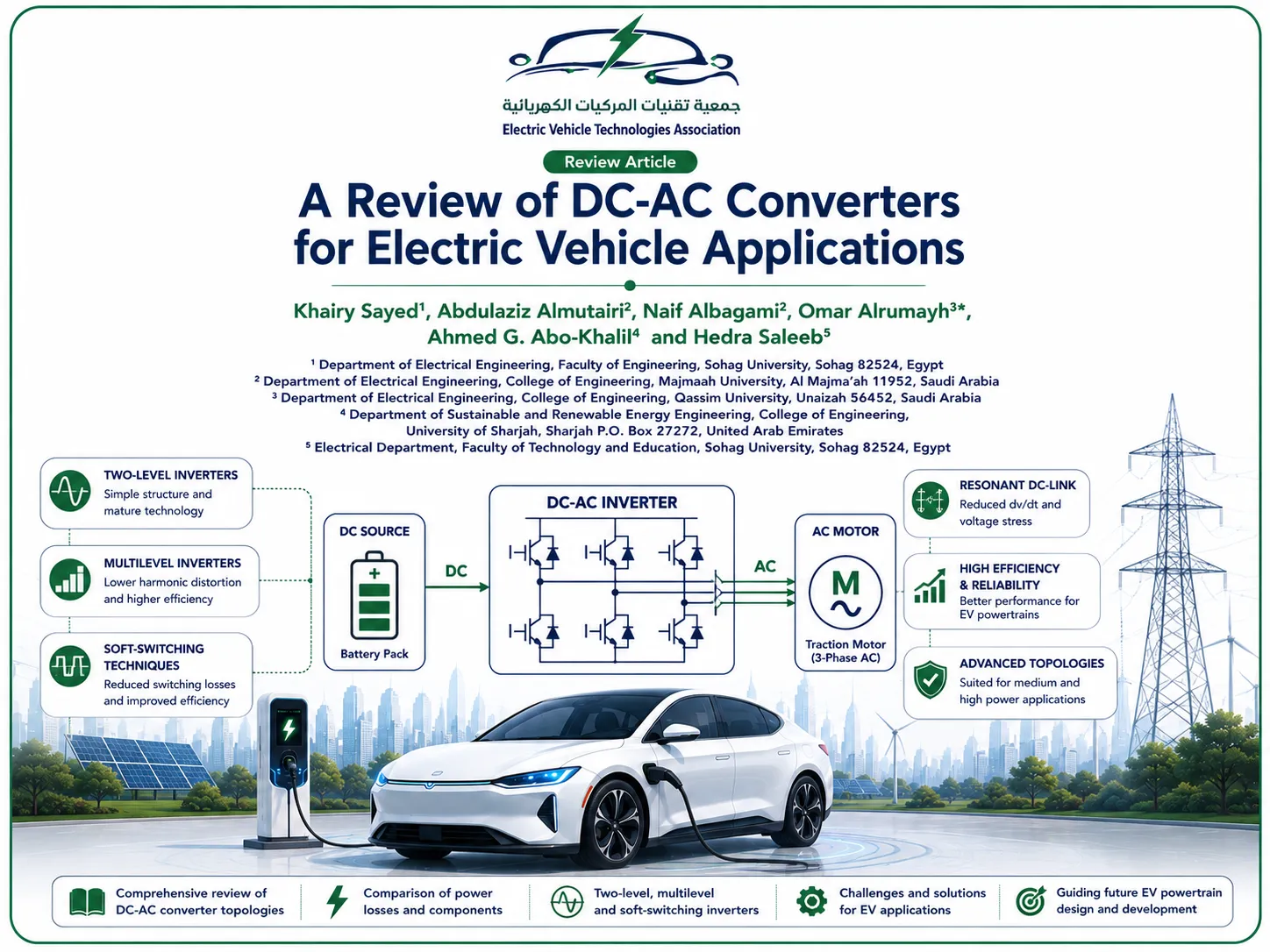
A Review of DC-AC Converters for Electric Vehicle Applications
Khairy Sayed, Abdulaziz Almutairi, Naif Albagami, Omar Alrumayh, Ahmed G. Abo-Khalil, Hedra Saleeb
Sohag University, Majmaah University, Qassim University, University of Sharjah
This review provides a comprehensive overview of DC-AC power converters for electric vehicle applications, focusing on power-electronics solutions for current and future EV technologies. It investigates and compares different medium- and high-voltage inverter topologies in terms of power losses and component requirements. The study also reviews two-level and multilevel inverter technologies, soft-switching techniques, and recent developments in EV motor-drive converters, providing a systematic classification of DC-AC converter topologies and highlighting their advantages, limitations, and potential for future EV applications.
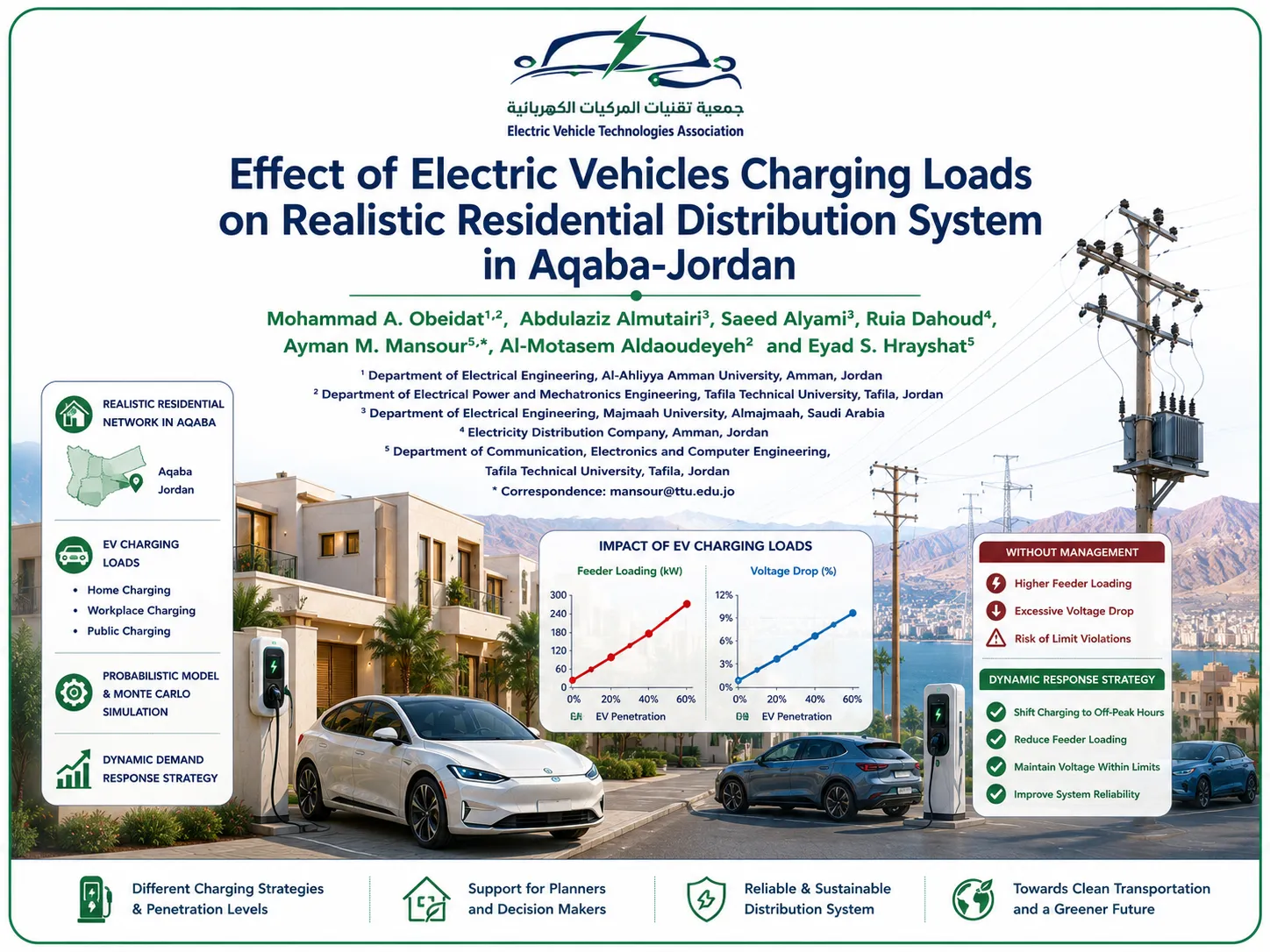
Effect of Electric Vehicles Charging Loads on Realistic Residential Distribution System in Aqaba-Jordan
Mohammad A. Obeidat, Abdulaziz Almutairi, Saeed Alyami, Ruia Dahoud, Ayman M. Mansour, Al-Motasem Aldaoudeyeh, Eyad S. Hrayshat
Al-Ahliyya Amman University, Tafila Technical University, Majmaah University, Electricity Distribution Company
This study investigates the impact of electric vehicle charging loads on a realistic residential distribution network in Aqaba, Jordan. It evaluates feeder loading and voltage drop under different EV penetration levels and charging strategies. A probabilistic EV load model is developed considering random driver behavior and battery characteristics using Monte Carlo simulation and CYME software. The study also proposes a dynamic critical-hours demand response strategy to shift EV charging away from periods in which feeder loading and voltage limits are violated. The results demonstrate that EV charging can significantly affect distribution network performance, while appropriate dynamic demand response can substantially mitigate these impacts.
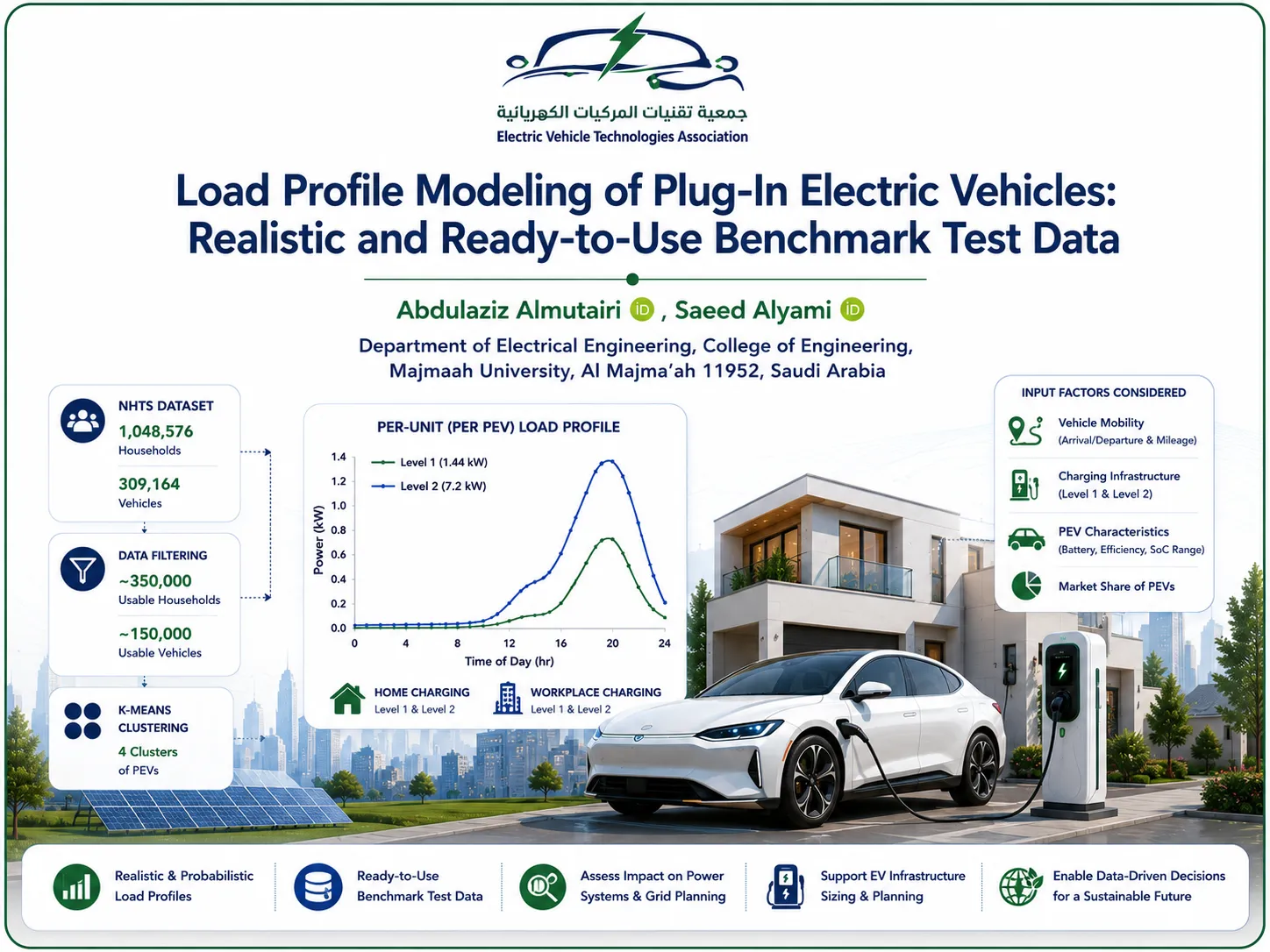
Load Profile Modeling of Plug-In Electric Vehicles: Realistic and Ready-to-Use Benchmark Test Data
Abdulaziz Almutairi, Saeed Alyami
Majmaah University
This study develops realistic and ready-to-use benchmark load profiles for plug-in electric vehicles (PEVs) by considering vehicle mobility, charging infrastructure, and PEV market share. The methodology uses filtered U.S. National Household Travel Survey (NHTS) data to estimate arrival time, departure time, and daily mileage. Commercially available PEVs are grouped into four clusters using the K-means algorithm, and per-unit load profiles are developed considering residential charging levels and vehicle characteristics. The resulting profiles provide reusable benchmark data for researchers, policymakers, and planners and are applied to analyze PEV loads in countries with high EV penetration.
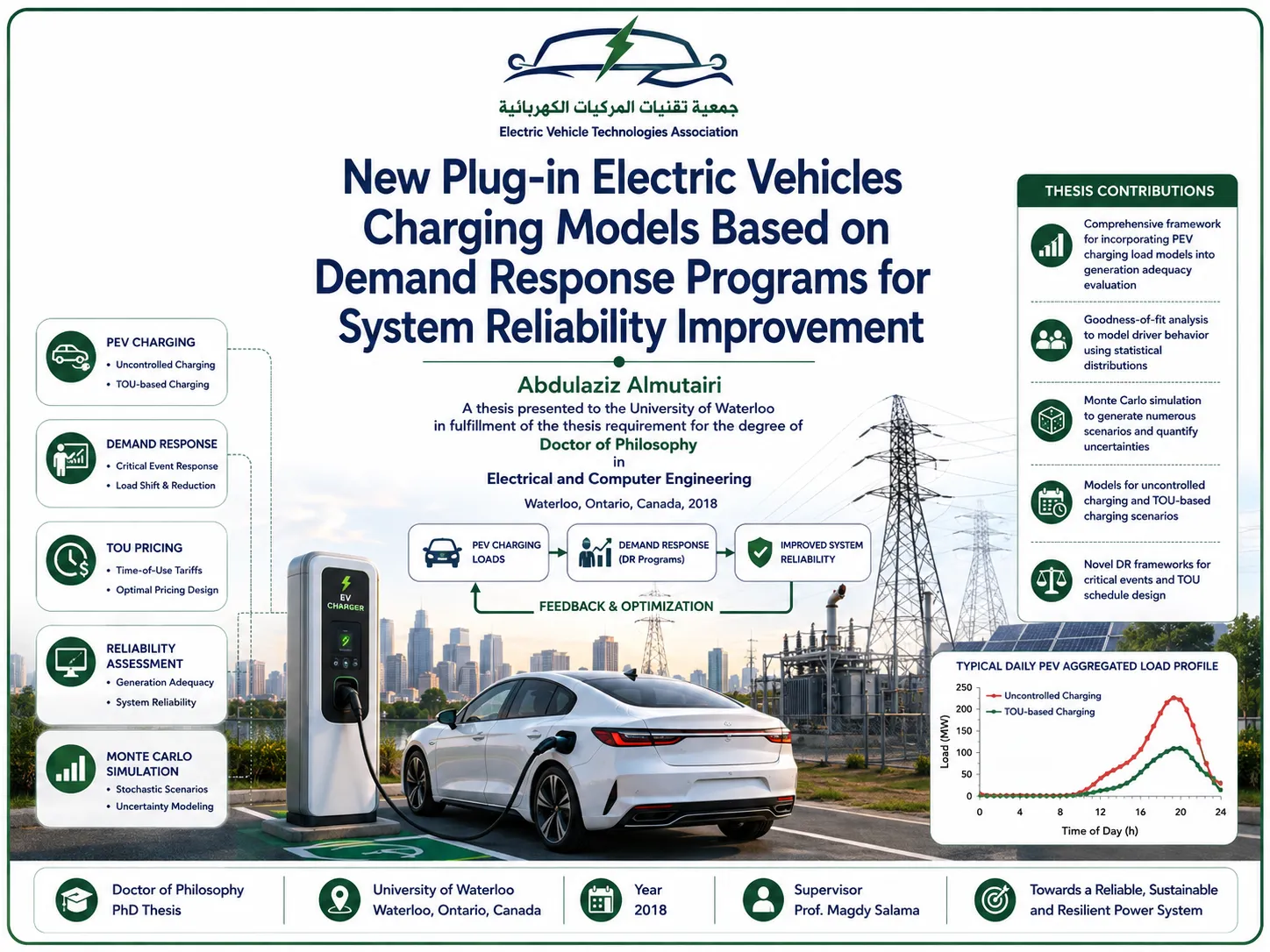
New Plug-in Electric Vehicles Charging Models Based on Demand Response Programs for System Reliability Improvement
Abdulaziz Almutairi
University of Waterloo
This thesis presents a comprehensive reliability framework for incorporating different plug-in electric vehicle (PEV) charging load models into generation adequacy evaluation. It applies statistical goodness-of-fit analysis and stochastic Monte Carlo simulation to model driver behavior, uncontrolled charging, and charging based on time-of-use (TOU) pricing. The research also proposes reliability-based demand response frameworks for managing PEV charging during critical system events and for designing TOU schedules that mitigate the adverse impact of uncontrolled charging while improving overall power system reliability.