

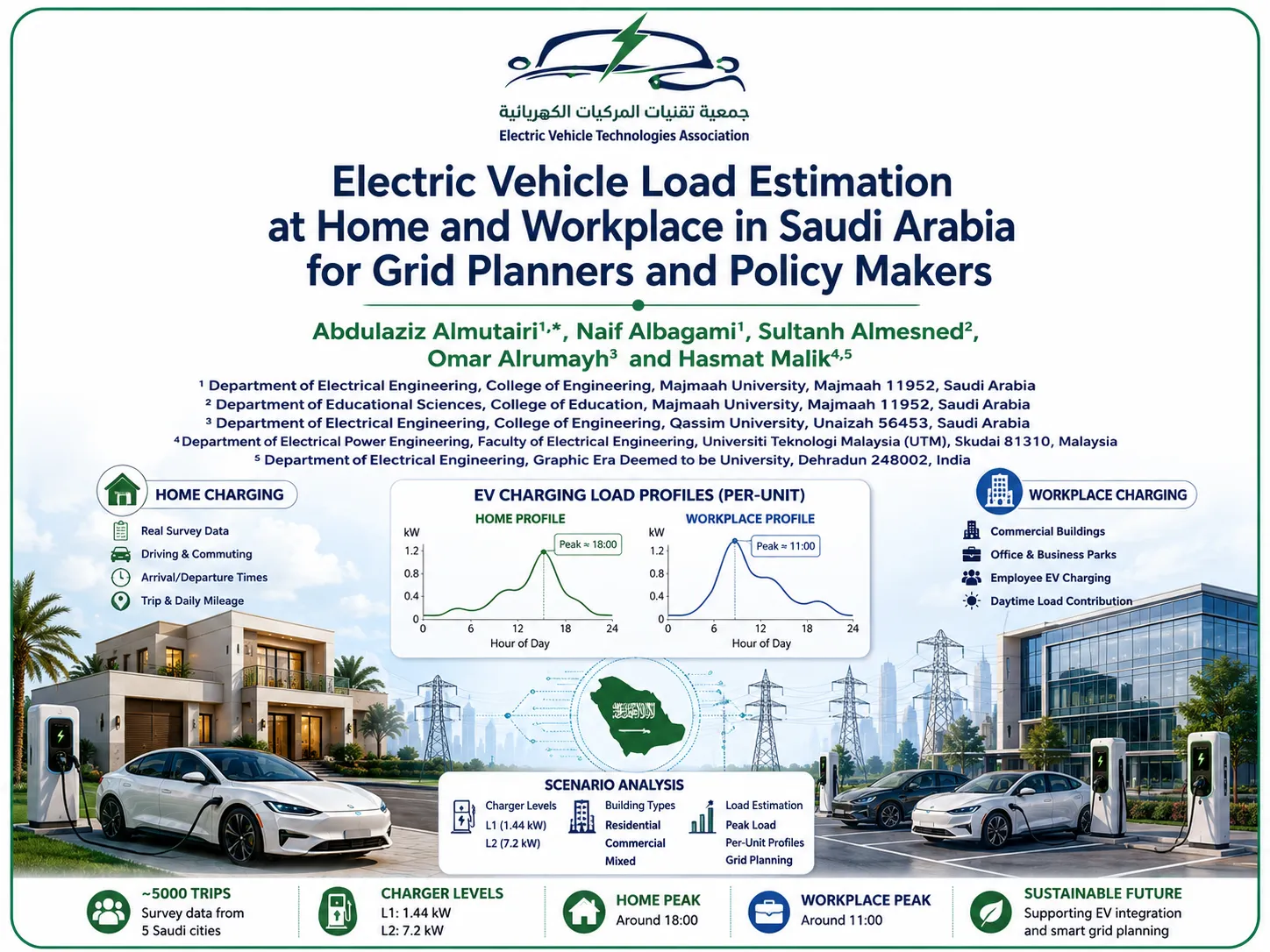
Electric Vehicle Load Estimation at Home and Workplace in Saudi Arabia for Grid Planners and Policy Makers
Abdulaziz Almutairi, Naif Albagami, Sultanh Almesned, Omar Alrumayh, Hasmat Malik
Majmaah University, Qassim University, Universiti Teknologi Malaysia (UTM), Graphic Era Deemed to be University
Sustainability
Abstract
This study proposes a tailored approach for estimating electric vehicle charging loads in Saudi Arabia using real survey data on driving and commuting behaviors. The methodology analyzes daily mileage, home and workplace arrival/departure times, and trip patterns to develop per-unit EV charging profiles. These profiles are then applied to different scenarios involving Level 1 and Level 2 chargers and residential, commercial, and mixed-use buildings. The results indicate that mixed-use buildings can reduce EV peak loads, with an approximately 50% commercial-to-residential ratio producing the lowest peak demand. The findings provide valuable information for grid planners and policymakers in planning EV charging infrastructure and managing future electricity demand.
Keywords
Charging Station; Electric Vehicle; Home and Workplace; Load Estimation; Peak Load; Per-Unit Profiles